



How symptom checkers work
Symptom checkers exist for a simple reason: most people start with incomplete information. You notice something feels "off," but you may not have the vocabulary (or the structure) to describe it clearly.
Most tools follow a similar workflow:
- they ask a fixed set of questions (often branching based on prior answers),
- they map your inputs to predefined symptom categories,
- they compare that profile to large datasets of conditions and typical presentations,
- they return a ranked list of possibilities and, sometimes, general urgency guidance.
This is essentially pattern matching. The system looks for combinations that resemble known cases, then scores matches based on frequency and similarity.
That approach is useful for turning a vague feeling into a more concrete description. It nudges you toward specifics—location, timing, intensity, associated signs—which can make your situation easier to summarize later.
The trade-off is compression. To work at scale, the tool has to simplify real life into discrete options. Mixed symptoms, uncertain timelines, complex histories, or "it depends" details may be forced into generic categories or ignored entirely.
What symptom checkers do well
Used as a tool for structuring information, symptom checkers can be genuinely helpful:
- they push you to name and categorize symptoms instead of describing them vaguely,
- they surface common and non-rare explanations early (often reducing noise from "worst case" thinking),
- they highlight potential warning signs worth paying attention to,
- they give you a consistent summary you can reuse when asking for help.
In practice, their best output is not the condition list—it’s the organized input you created while answering.
Where symptom checkers fall short in real-world use
Most symptom checkers struggle with context because they don’t "understand" the situation—only the selected inputs.
Common limitations include:
- weak handling of timelines (what changed, when, and in what order),
- difficulty combining multiple symptoms that interact,
- limited ability to weigh medical history, medications, and baseline health together,
- no real awareness of what decision you’re trying to make.
As a result, outputs can feel broad. You may get a long list without clarity on what matters most for you, which details would meaningfully reduce uncertainty, or what the tool could be missing.
Even when the list contains the "right" item, it may be difficult to tell why it appeared, what drove the ranking, and whether your context should push it up or down.
The role of context in medical decisions
Medical reasoning depends heavily on context: who the patient is, what came before, and what changed.
The same symptom can mean very different things depending on factors like baseline health, age, recent exposures, recent medication changes, and how quickly the issue evolved. This isn’t just "more data." It is prioritization—deciding what matters first, what is less likely, and what should not be missed.
Context often includes:
- a clear timeline (start, progression, fluctuations),
- relevant background (conditions, medications, prior episodes),
- constraints (what you tried, what helped, what made it worse),
- the decision pressure (what you’re trying to choose between right now).
That is why structured communication matters. A well-framed question that includes symptoms, timeline, and background allows a clinician to apply reasoning rather than rely on probabilities alone.
If you are unsure how to structure such a question, a practical guide is available in this article on writing clear medical questions.
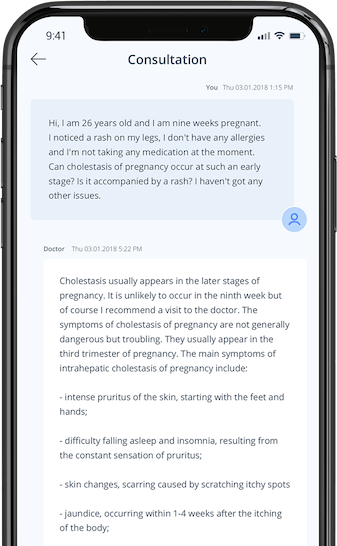
Asking a doctor: what changes
When you ask a doctor, the goal is not just to generate possibilities. The goal is to narrow them in a way that supports a decision.
A clinician can:
- interpret symptoms in context (including what is more or less likely for you),
- recognize subtle red flags and meaningful inconsistencies,
- explain reasoning in plain terms, not just provide a ranked list,
- identify what missing information would change the conclusion.
This typically creates a more targeted conversation: what is relevant, what is likely not relevant, and what would actually move the decision forward.
The quality of the answer still depends on the quality of the information provided. A clear summary (symptoms + timeline + background + your question) usually produces a clearer response.
If you are preparing information for a more complex case or follow-up, this guide on preparing medical data for a second opinion may help.
When a symptom checker may be enough
In some situations, a symptom checker can be sufficient as a first-pass tool:
- mild, short-lived symptoms with a clear trigger,
- situations where you mainly want a structured way to describe what you’re noticing,
- early exploration before deciding whether it’s worth seeking help.
Here, the value is speed and organization. You get a low-effort way to label the experience, sanity-check obvious possibilities, and build a short summary you can reuse if needed.
When asking a doctor is the better choice
Asking a doctor is usually more effective when:
- symptoms persist, change, or worsen over time,
- multiple symptoms interact and the picture is not straightforward,
- medical history or medications complicate interpretation,
- the main goal is decision-making rather than curiosity.
When the question is "what should I do next?" (monitor, adjust, investigate, or rule something out), professional interpretation is often more useful than a ranked list—because it focuses on relevance, uncertainty, and impact.
Combining both approaches effectively
Symptom checkers and medical consultations do not have to compete. Used together, they can complement each other.
A symptom checker can help you organize your observations. A doctor can then interpret that structured summary and connect it to a decision. A practical workflow is:
- use the checker to list symptoms and timing clearly,
- turn that summary into a focused medical question,
- state what you’re trying to decide (not only what the symptom "could be").
Understanding the strengths and limits of each tool helps you choose the right approach at the right time.